
Basic Bookkeeping Principles — Part 1

(Debits, Credits, Double Entries, T-Accounts and Trial Balance)
What are debits and credits in bookkeeping terms, and what is the meaning of a double-entry and a T-Account?
In any transaction there are always two issues at play — the giving and receiving of an item or service. Someone gives and someone receives something and therefore two accounts in the books of a company are always affected — one is debited and the other credited. This is what is called a double-entry.

In bookkeeping terms there are five types of accounts, namely: assets (what you own), liabilities (what you owe), equity (your own and other shareholders’ investment as well as retained income to fund the company), revenue (the service or goods that you sell), and expenses (the expenses that you incur to generate revenue).
Asset accounts consist mainly of the following type of accounts: fixed assets (land & buildings, motor vehicles, furniture, computer equipment, etc.), other investments and current assets (bank, stock, trade debtors, sundry debtors, petty cash, etc.), and these normally have debit balances. Therefore, to increase an asset account it is debited and to decrease the account it is credited.
Liability accounts consist mainly of the following accounts: long term liabilities (shareholder loans, mortgage loan, leases and loans that are due longer than 12 months from a specific date) and current liabilities (short term loans, trade creditors, sundry creditors, bank overdraft, etc.) The liability accounts have credit balances. Therefore, to increase a liability account, it is credited and to decrease the account, it is debited.
Equity accounts consist mainly of: Ordinary shareholders’ equity (ordinary share capital and retained earnings/loss) and preference share capital. The equity accounts have credit balances and therefore, to increase an equity account, it is credited and to decrease the account, it is debited.
Revenue accounts record the various activities from business activities and can consist of cash sales, credit sales, services rendered, other income, etc. These accounts have a credit balance and therefore, to increase the account it is credited and to decrease the account it is debited.
Expense accounts are the cost involved in generating revenue and include rental, salaries, vehicle expenses, delivery expenses, fuel, telephones, etc. These accounts have a debit balance and therefore, to increase the account it is debited and to decrease the account it is credited.
Also, important to note is that during a specific financial year, the income and expenses of the company are debited or credited to a profit and loss account and at the financial yearend, the net result, after taxes and dividends, are debited or credited to the retained earnings/loss account. This is done to see whether the company is profitable or not.
T-Accounts explained.
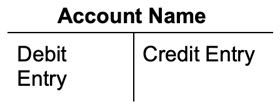
A T-account (or general ledger account) is a graphical representation of a general ledger account. The general ledger is an accounting report that sorts and records a business’ financial transactions, by account.
A T-account is identified as a T-account, simply because it visually resembles the letter T. Debit entries are always on the left side and credit entries are on the right side as shown below.
Of course, these days cloud accounting software packages are available and there is no need to generate t-accounts anymore. However, the understanding of T-Accounts remains important and can be especially useful in working through complex financial transactions.
8 Examples of T-Accounts (no currency is used as these examples can apply to any currency)
1. Owner’s Investment
The owner of ABC company invests 50 000 into his business. The amount is paid into the company’s bank account. As we have already established, a Bank account is an asset and to increase an asset account it is debited. Similarly, the Owner’s Capital account is an equity account and to increase this account it is credited. Therefore, the Bank account is debited with 50 000, and the Owner’s capital account credited with 50 000.

2. Consulting Fee Earned and Collected
ABC company provides a consulting service to a client and charges them a consulting fee of 5 000 and receives immediate payment from the client. The Bank account (asset) is increased by debiting the Bank account. The Revenue Account is credited to increase the revenue of the company. Therefore, the Bank account is debited with 5 000, and the Revenue account is credited with 5 000.

3. Purchase Stock on Terms
ABC company negotiates terms with a supplier of stock and is given 30 days from date of statement. They purchase stock to the value of 7 500. The stock account (asset) is increased by debiting the stock account. The Accounts Payable (liability) is credited to increase the liability for payment in the future. Therefore, the stock account is debited with 7 500, and the Accounts Payable account is credited with 7 500.

4. Pay Accounts Payable According to Terms Agreed Upon
The stock bought on terms is now due and payable. The Bank Account needs to be reduced, and as it is an asset account, it is credited to reduce the balance. The Accounts Payable Account (liability) also needs to be reduced and therefore it is debited with 7 500. The Stock Account, of course, remains the same as the stock has been bought and paid for.

5. Purchase of Equipment
The company decides to purchase a desk for the new secretary for 2 750 and pays cash for it to utilize the 2.5% settlement discount offered by the supplier. The Bank Account (asset) is decreased by crediting the Bank Account. The Fixed Asset Account (asset) is debited to increase the assets of the company and the Discount Received Account credited to increase the Revenue. Therefore, the Bank Account is credited with 2 681.25 (2 750 minus 68.75 discount), the Fixed Asset Account is debited with 2 750 (the full value of the asset), and the Discount Received Account credited with 68 .75

6. Pay Salary
At the end of the month the secretary receives a salary of 4 500. The Bank Account needs to be reduced by 4 500, and as it is an asset account, it is credited to reduce the balance. The Salaries Account (expense) needs to be increased and therefore it is debited with 4 500.

7. Rental for Office Premises Paid
An amount of 6 250 is paid at month end in respect of rental for the office premises. The Bank Account needs to be reduced by 6 250, and as it is an asset account, it is credited to reduce the balance. The Rental Account (expense) needs to be increased and therefore it is debited with 6 250.

8. Stock Sold on Credit
The stock purchased before, is now sold to a client at a markup of 40% on 30-day terms —10 500 (7 500 plus 40%). The Stock Account (asset) needs to be reduced by the cost amount (7 500), the Revenue Account (Income) needs to be increased by the full selling price, the Cost of Sales Account (expense) needs to be increased with the cost price of the stock, and Account Receivable Account (asset) increased by the full selling price. Therefore, the Credit Sales Account (revenue) is credited with 10 500 (7 500 cost of stock plus 3 000 markup), the Accounts Receivable Account (asset) is debited with 10 500, the Stock Account (asset) is credited with 7 500, and the Cost of Sales Account (expense) is debited with 7 500.

Please note that the numbers shown in brackets next to the amounts in the examples above and below, refer to the 8 examples above for easy reference.
Detailed General Ledger
From the above few examples, we have now prepared detailed ledger accounts for all the transactions of the company, also known as a Detailed General Ledger.

Trial Balance
A trial balance is a list of the balances of all the individual accounts in the Detailed General Ledger to see whether the debit and credit balances are equal and that no mistakes have been made. As mentioned before, accounting software ensures that an entry must balance and automatically generates a trial balance, but this is necessary to understand the basic principle.

In part 2 of Basic Bookkeeping Principles, we will discuss journal entries for depreciation of assets, provisions, and other non-cashflow entries that are normally made. If you would like more clarity on any aspects of Basic Bookkeeping Principles, you can get more information here.

Comments